The Ache of 'Not Enough'
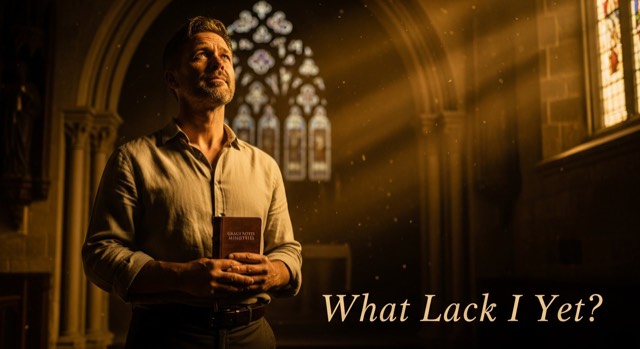
There's a particular kind of quiet that settles in around 3 a.m., when the hum of the world fades and the hum of your own soul gets louder. You've done the right things, haven't you? You paid your bills on time, you were patient in the checkout line, you even managed to hold your tongue when you really wanted to let it fly. You've built a respectable life, a good life by most measures, brick by careful brick. Yet in that profound stillness, a question echoes in the chambers of your heart, a question you're almost afraid to form into words: Is this it? Is this enough? It's the ache of the almost, the nagging sense of a crucial missing piece in a puzzle that looks complete from a distance.
A young man, breathless with earnestness, once ran up to Jesus with this very same ache driving him forward. Look at him in Matthew’s gospel; he is respectable, he is disciplined, he is successful. He comes to Christ not with a confession, but with a resume, asking, “Good Master, what good thing shall I do, that I may have eternal life?” He believes salvation is a transaction, the final achievement for a life of achievements. But Jesus, with surgical precision, immediately cuts to the heart of the matter, turning the question back on itself. “Why callest thou me good?” He asks, “there is none good but one, that is, God.” In one stroke, Jesus shifts the entire conversation away from the shaky ground of human performance and onto the solid rock of God’s exclusive, absolute goodness, beginning the work of dismantling the man’s whole religious framework.
And here's the thing. When Jesus lists the commandments, He picks the ones that govern our relationships with other people, the ones we can most easily convince ourselves we're keeping. “Thou shalt do no murder, Thou shalt not commit adultery, Thou shalt not steal…” The young man’s swift, confident reply is so telling, so tragically human: “All these things have I kept from my youth up: what lack I yet?” He genuinely believes he has a passing grade. He cannot see that the law was never given as a ladder to help us climb up to God; it was given as a mirror to show us how far we've fallen and how desperately we need a rescuer. His haunting question, “what lack I yet?” isn't the query of a disciple seeking wisdom, but the cry of a soul that has mistaken the hard labor of rule-keeping for the joyful rest of a relationship.
The young man saith unto him, All these things have I kept from my youth up: what lack I yet?— Matthew 19:20, KJV
The Futility of the Scorecard
We all carry a little ledger around in our souls, don't we? A private scorecard where we meticulously track our debits and credits with God. A good deed here, a prayer there, a moment of self-control—these are our assets. A sharp word, a selfish thought, a duty neglected—these are our liabilities. We live under the tyranny of this internal balance sheet, hoping that by the end of the day, or by the end of our lives, the good column will outweigh the bad. The rich young ruler was a master accountant of his own soul, and his books seemed to be in order. But his entire system of self-reliance was built on an idol he couldn't see until Jesus pointed to it: his great possessions. When the test came, his spiritual scorecard couldn't bear the weight of a single, true sacrifice, and his whole structure of self-righteousness crumbled.
Now, stand in that wreckage for a moment and hear the good news that blows through it like a cleansing wind. Eternal life is not the final prize for a life well-lived; it is the free gift for a life surrendered. Jesus didn't meet that young man to give him one more rule for his list; He came to fulfill all the rules and nail the condemning list to His cross. The young man’s question was all about what *he* could do, but the gospel thunders a different answer entirely, an answer that revolves around what Christ *has done*. There is a place where the scorecard is burned to ash, where the guilt is permanently cancelled, where the striving ceases. This place is the finished work of Jesus Christ on Calvary, and it is the only place you will ever find true, lasting peace.
Consider how Jesus Himself defines the very prize the young man was seeking. In His great prayer to the Father in John’s seventeenth chapter, He gives us the divine definition. He doesn't say, “This is life eternal, that they keep all the rules.” He doesn't say, “This is life eternal, that they do many good things.” No. He prays, “And this is life eternal, that they might know thee the only true God, and Jesus Christ, whom thou hast sent.” Do you see the staggering difference? The ruler was asking for a task, a transaction, a contract to secure a property called 'eternal life.' Jesus was offering a relationship. An intimate, personal, transforming knowledge of the Father through the Son. The man was focused on the work of his hands, and Jesus was inviting him into the love of His heart.
And this is life eternal, that they might know thee the only true God, and Jesus Christ, whom thou hast sent.— John 17:3, KJV
From Doing to Being
This ancient story breathes in our modern lives every single day. It’s there in the parent’s heart who, after losing their temper with a child, spends the rest of the evening trying to 'make up for it' with kindness, as if balancing a scale. It’s in the quiet pride we feel after a consistent week of Bible reading, subtly believing we've earned a little more of God's favor. It's the secret panic that sets in when we fail, the fear that we've exhausted His patience this time, that we've finally overdrawn our account. The gospel liberates us from this exhausting spiritual bookkeeping. It announces that the scales have been destroyed, the ledger has been wiped clean by the blood of the Lamb, and we can finally approach our Father not with a resume of our accomplishments but with the empty, open hands of a child ready to receive everything from Him.
So please, hear this with a pastor's heart. Stop trying to fix yourself. Stop scrambling to be better, to be worthy, to finally get it right. You can't. You never will. The ladder you're trying to climb doesn't reach heaven, and the effort is draining the life right out of you. Jesus is not at the top of the ladder, waiting for you to arrive; He is the solid ground beneath your feet, having already come down to you. Your standing with God does not rise and fall with your spiritual performance. You are loved today not because you were good today, but because He is God, and He is good. Rest in His finished work. Let His perfect righteousness be your only claim, your only confidence, your only plea.
Living in this grace changes everything. It means our repentance is no longer a frantic performance to get back on God's good side, but a sorrowful, grateful turning back to the Father who was already running to meet us. It means we serve, give, and love not as indentured servants trying to pay off an impossible debt, but as beloved children who are so overwhelmed by our inheritance that we can't help but share it. We don't just 'suffer the little children' to come to Jesus; we become like them. We come with nothing to offer but our need. We come with total trust. We come without a list of our accomplishments, knowing that the only thing that matters is that His arms are open to receive us.
But Jesus said, Suffer little children, and forbid them not, to come unto me: for of such is the kingdom of heaven.— Matthew 19:14, KJV
There is None Good But One
Let us plant our feet here, on this unshakeable, foundational truth. The entire edifice of our faith rests on the simple, devastating, and ultimately liberating statement Jesus made to that earnest young man. The core problem was not in the young man's list, but in his premise. His question, “what good thing shall I do?” was broken from the start because it assumed that human goodness was the currency of salvation. Jesus’s response, “there is none good but one, that is, God,” is not a casual remark; it is the bedrock of the gospel. It dynamites our pride, it exposes the futility of our self-improvement projects, and it forces us to look away from ourselves and wholly onto His mercy. God’s promise is not that He will help us become good enough for Him, but that in Christ, He has become good enough for us.
And because this is true, the most dangerous thing for a believer is to walk away from this grace and return to the chains. The temptation will always whisper to you, urging you to pick up the old scorecard, to start tallying your spiritual performance once more. Legalistic religion is seductive because its rules feel tangible and controllable, offering a false sense of security. But it is a beautifully decorated prison cell. To go back to measuring your worth by your works is to forget the meaning of the cross. It is to do exactly what the rich young ruler did: to hear the radical call of grace and to turn and walk away sad, because the cost of holding onto our own righteousness is everything. Don't walk away sad. Stay with the only One who is Good.
And he said unto him, Why callest thou me good? there is none good but one, that is, God: but if thou wilt enter into life, keep the commandments.— Matthew 19:17, KJV
So tonight, when the house is quiet and the nagging questions begin to surface, let the answer not be found in a review of your day’s performance. Let it be found at the foot of the cross. The ache of 'what lack I yet?' is perfectly and eternally answered in the Person of Jesus Christ. He is what you lack. He is the righteousness you could never achieve, the perfection you could never attain, the peace you could never manufacture. The invitation of the gospel is not to do one more good thing. It is to stop doing, stop striving, stop earning, and simply fall into the strong and loving arms of the only One who is good. Rest there tonight. Dwell there tomorrow. And build your whole eternity on that solid, gracious ground.